
McKinsey & Company reports that predictive maintenance can reduce machine downtime by up to 50% and increase machine life by 20% to 40%, making it one of the most significant advances in infrastructure management in recent decades. As critical infrastructure systems become more interconnected and dependent on continuous operation, organizations are looking for ways to prevent costly disruptions before they occur. Professionals involved in maintaining electrical and energy systems, including those working alongside a licensed electrician Chester County PA, are increasingly seeing the value of technologies that identify potential failures before equipment breaks down.
Critical infrastructure supports everyday life. Power distribution systems, manufacturing facilities, water treatment plants, transportation networks, and commercial buildings all depend on equipment operating reliably. When a transformer, motor, switchgear assembly, or control system unexpectedly fails, the consequences can extend far beyond repair costs. Service interruptions can affect businesses, public services, and entire communities.
The Growing Challenge of Unexpected Equipment Failures
Traditional maintenance strategies generally fall into two categories: reactive maintenance and preventive maintenance. Reactive maintenance involves fixing equipment after it fails. Preventive maintenance relies on scheduled inspections and component replacements based on time intervals.
While preventive maintenance is an improvement over waiting for failures to occur, it still has limitations. Equipment does not always wear out according to a schedule. Some components fail earlier than expected, while others continue functioning well beyond planned replacement dates. This uncertainty can lead to unnecessary maintenance costs or unexpected breakdowns.
The U.S. Department of Energy notes that unplanned downtime in industrial facilities can cost organizations thousands or even millions of dollars depending on the nature of operations. Data from the department highlights how equipment failures often create cascading effects, delaying production schedules, disrupting supply chains, and increasing operational expenses.
As infrastructure systems become more complex, relying solely on routine inspections is becoming increasingly difficult. Operators need better visibility into the actual condition of assets rather than assumptions based on age or service intervals.
How Predictive Maintenance Bridges the Gap
Predictive maintenance offers a practical solution by using real-time data to assess equipment health and predict future failures. Rather than replacing parts on a fixed schedule, organizations can perform maintenance when indicators show that a problem is developing.
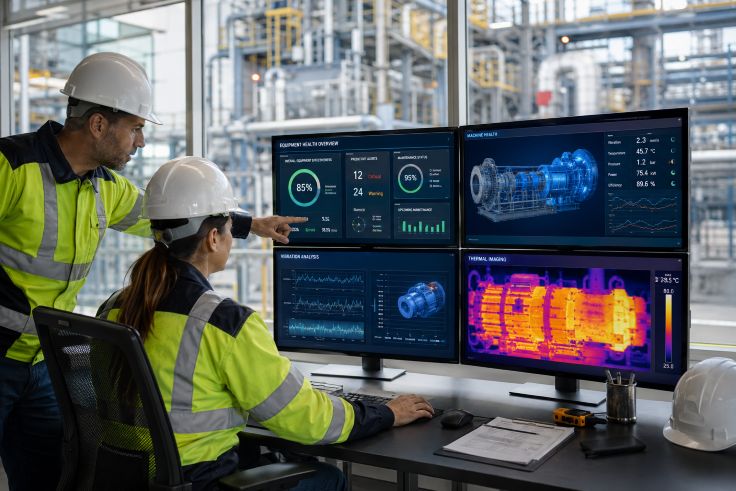
The approach relies on a combination of sensors, monitoring systems, software analytics, and machine learning tools. These technologies continuously collect information from equipment and identify patterns associated with wear, degradation, or abnormal performance.
Common predictive maintenance technologies include:
- Vibration monitoring for motors, pumps, and rotating equipment
- Thermal imaging to detect overheating electrical components
- Ultrasonic testing for leaks and mechanical issues
- Oil analysis for machinery condition assessment
- Remote monitoring systems connected through industrial networks
- Artificial intelligence models that identify early warning signs
The International Energy Agency (IEA) notes that digital monitoring technologies are playing an increasingly important role in improving infrastructure reliability and energy efficiency. By turning operational data into actionable insights, organizations can make better maintenance decisions and reduce unexpected failures.
Benefits for Industrial Energy Projects
Industrial energy projects often involve high-value equipment operating under demanding conditions. Generators, substations, transformers, switchgear, pumps, and electrical distribution systems must perform reliably to maintain productivity and safety.
Predictive maintenance provides several advantages in these environments.
Reduced Downtime
One of the most immediate benefits is the reduction of unplanned outages. Monitoring systems can detect small issues before they become major failures. Maintenance teams can schedule repairs during planned shutdowns rather than responding to emergencies.
Research published by Deloitte indicates that predictive maintenance programs can lower breakdown rates significantly while improving equipment availability. Increased uptime directly supports operational efficiency and revenue generation.
Improved Safety
Electrical and industrial equipment failures can create safety risks for workers and facility occupants. Overheated connections, insulation breakdowns, and mechanical defects may lead to fires, arc flashes, or equipment damage.
By identifying these issues early, predictive maintenance supports safer working environments. Thermal imaging inspections and condition monitoring tools provide visibility into risks that may not be visible during routine visual inspections.
Lower Maintenance Costs
Maintenance budgets can be optimized when repairs are based on actual equipment conditions. Organizations avoid replacing components prematurely while reducing the expense associated with emergency repairs.
IBM notes that condition-based maintenance strategies help organizations allocate resources more efficiently by focusing attention where it is needed most. This targeted approach supports long-term asset management goals.
Extended Asset Lifespan
Infrastructure assets often represent major capital investments. Predictive maintenance helps maximize the value of these investments by identifying operating conditions that accelerate wear and tear.
Early detection of alignment problems, excessive vibration, temperature fluctuations, and electrical abnormalities can prevent secondary damage and prolong equipment service life.
The Role of Skilled Electrical Expertise
Technology plays a critical role in predictive maintenance, but data alone does not solve infrastructure challenges. Skilled professionals remain essential for interpreting findings, performing repairs, and implementing system improvements.
Electrical specialists understand how monitoring data relates to real-world operating conditions. When predictive tools identify abnormal temperature readings, voltage irregularities, or equipment degradation, experienced technicians can determine the appropriate corrective actions.
Field expertise is particularly important in complex electrical environments where multiple systems interact. Electrical contractors, energy specialists, and maintenance professionals contribute practical knowledge that complements digital monitoring technologies.
Many modern infrastructure projects combine advanced analytics with hands-on inspections, testing procedures, and engineering assessments. This integration helps ensure that maintenance recommendations are accurate and actionable.
Future Adoption Trends
The adoption of predictive maintenance continues to accelerate as sensor costs decline and data analytics become more accessible. Organizations that once relied on manual inspections now have access to cloud-based monitoring platforms capable of tracking thousands of assets simultaneously.
Gartner has identified predictive asset management as a growing priority across industries seeking greater operational resilience. The combination of artificial intelligence, industrial internet of things (IIoT) devices, and advanced analytics is expected to expand predictive maintenance capabilities even further.
Future systems may provide increasingly accurate forecasts regarding component failures, maintenance scheduling, and asset performance optimization. Digital twins, which create virtual models of physical equipment, are also expected to play a larger role in infrastructure management. Similar advances can be seen in energy-efficient equipment technologies, where continuous monitoring and adaptive performance controls help reduce energy consumption while extending system lifespan.
Utilities, industrial facilities, transportation networks, healthcare campuses, and commercial properties are likely to continue investing in technologies that improve reliability while controlling operational costs.
Conclusion
Unexpected equipment failures remain one of the biggest challenges facing critical infrastructure operators. Reactive repairs and fixed maintenance schedules often struggle to address the growing complexity of modern systems. Predictive maintenance bridges this gap by using real-time monitoring, data analytics, and condition-based insights to identify problems before they become disruptive failures.
Research from organizations such as McKinsey & Company, Deloitte, the U.S. Department of Energy, and the International Energy Agency demonstrates the measurable benefits of predictive maintenance, including reduced downtime, improved safety, lower costs, and longer asset life. As adoption continues to expand, the combination of advanced monitoring technologies and experienced electrical professionals will play a central role in keeping critical infrastructure reliable, efficient, and resilient for years to come.